
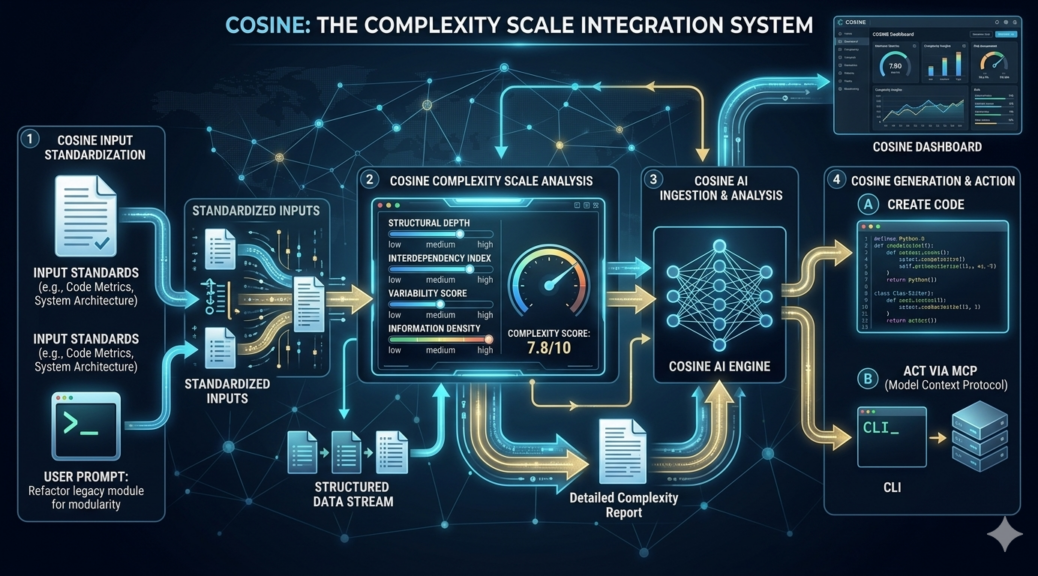
This blog post introduces COSINE, a framework designed to move AI automation from “guessing” to “engineering.” It treats complexity as a measurable metric rather than a feeling.
Beyond the Prompt: Introducing COSINE (COmplexity Scale INtegration systEm)
We have reached a plateau in AI automation. The initial “magic” of asking an LLM to do everything is wearing off, replaced by a harsh reality: AI is expensive, slow, and sometimes hallucination-prone for tasks that a simple script could solve in milliseconds.
The industry is currently suffering from “Agentic Overkill.” We are building massive, probabilistic chains for problems that have a deterministic core. To solve this, we need a governor—a system that measures the “angle” of a task before a single token is spent.
Enter COSINE: the COmplexity Scale INtegration systEm.
What is COSINE?
COSINE is an architectural layer that sits between a user’s intent and the execution engine. It doesn’t just “run” a prompt; it analyzes the task against a set of Engineering Standards to decide the most efficient path to completion.
The COSINE workflow follows a strict logic:
- Input: User Prompt + Standardized Complexity Constraints.
- Analysis: The system calculates a Complexity Index ($C$).
- Bifurcation: * Low $C$: COSINE instructs the AI to generate and execute local code.
- High $C$: COSINE engages the AI as an agent to act via MCP (Model Context Protocol).
The Metrics: Measuring Complexity
Instead of “vibes,” COSINE uses established software engineering principles to grade a task:
- Data Entropy ($H$): How unstructured is the input? High entropy (unstructured text/images) pushes the score toward AI; low entropy (JSON/SQL) pulls it toward code.
- Cyclomatic Complexity ($M$): If the logic requires a high number of decision paths (linearly independent paths through the code), it may be too brittle for a script and better suited for an LLM’s reasoning.
- Space-Time Requirements: If the task requires processing 10,000 records in <1 second, the Complexity Index forces a Code-only output.
A simplified version of the COSINE decision formula might look like this:
$$C = \omega_1(H) + \omega_2(M) – \omega_3(\text{Determinism})$$
Where $\omega$ represents the weight of each factor based on your specific system requirements.
The Two Paths of COSINE
1. The Synthetic Code Path (Low Complexity)
If COSINE determines the task is deterministic and has low entropy, it doesn’t “perform” the task using an LLM. Instead, it uses the AI as a compiler. The AI generates a self-contained Python or JavaScript script, executes it in a sandboxed environment, and returns the result.
- Benefit: 100% accuracy, zero recurring token cost for the logic, and instant execution.
2. The Agentic MCP Path (High Complexity)
When the complexity exceeds the threshold—meaning the task requires environmental awareness, iterative reasoning, or access to live external data—COSINE activates the Model Context Protocol (MCP).
- The Action: The AI acts as an operator, using MCP to “plug in” to your databases, Slack, or local file systems to perform multi-step reasoning that code alone cannot capture.
Why COSINE Matters
By implementing COSINE, we move away from “Prompt Engineering” and toward System Engineering. We stop wasting the “brainpower” of Large Language Models on trivial logic. We save the expensive, probabilistic reasoning of the LLM for the truly “messy” problems, while letting the cold, hard efficiency of code handle the rest.
In the world of 2026 automation, we don’t need smarter models; we need a smarter scale. We need COSINE.